Comments Off on Mobile web data stats, hard to measure and to interpret

Mobile web data stats, hard to measure and to interpret

{}
April 12th, 2011

PPK is a informative source for developments on the web, especially the mobile web. since he turned away from javascript the last years.

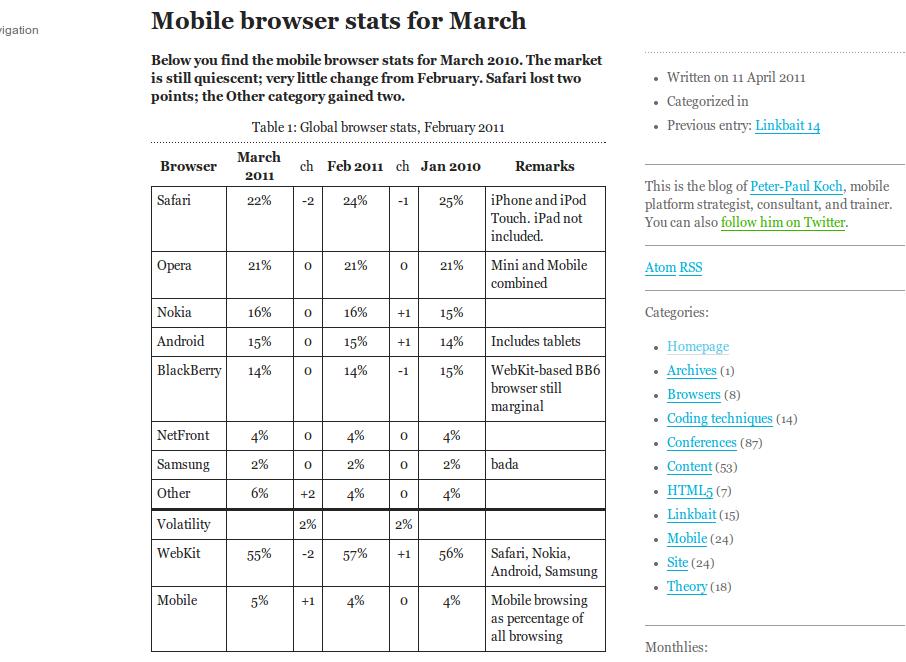
Still I doubt his analysis of his monthly Mobile browser stats can stand the test for science. (Webp image screenshot, saved 45% compared to jpg. supported by Chrome and Opera, click to see jpg) or follow link.

A few questions raised:

  1. What do I actually see, how is the market share defined?
    bandwidth, server logs, requests, time, analytics, users, User Agent strings?
  2. There seems to be mixing up of platforms and browsers: I use Opera on Android, in which row do I belong?
    Opera or Android. You expect Opera, but in his words he expected Android to have passed Blackberry. Well, they just put me in the wrong category!
  3. Opera is using compression proxy servers that will lower the bandwidth with up to 50%.
    Opera is also pre-formatting content (OBML), compressing images to the new WebP pcture format (much better then jpg), and minimizing the amount of server requests, which is slowing mobile web quite severely. That also makes traffic difficult to measure and compare to other platforms. And then competition has started similar services: Bitstream Bolt and UC browser.
  4. I use my Android mostly at home or at my desk using ADSL landlines. Is that mobile web?
    Statcounter should break down their numbers to platform, browser and provider/data carrier. We need to differentiate between WIFI, and GSM/UTMS. Is Mobile web  defined by device or by usage/location.

Don’t get me wrong, I really like PPK and his works, and I know he is at least trying to get some order in the chaos of mobile life, and he is working with the data provided by Statcounter.

On the other hand, maybe the absolute numbers are wrong, if you don’t change your methods, trends still remain visible. I keep reading PPK Quirksblog.

Comments Off on HTML5 date type input fields, not perfect yet

HTML5 date type input fields, not perfect yet

{}
February 25th, 2011

One of the most handy improvements of HTML5 will be the added functionality to forms. Sliders, spinners and datepickers are foreseen and IMHO will be extremely valuable. No need anymore for the Jquery datepickers, which are nice but quite a hassle for a thing that should be standard: inputting a date.

Opera is the only browser that supports the HTML5 type=datetime attribute at the moment.
Unfortunately there are  some pitfalls.

What is the right date-format?

The HTML spec states several valid datetime formats. Opera doesn’t parse these correctly.

Birthday of Nero: 0037-12-13T00:00Z

Why is this a valid date 2010-09-30T12:00:00 while the default MySQL output 2010-09-30 12:00:00 isn’t? That’s just plain stupid.
It means that every webdeveloper needs to add extra steps to parse the database fields with extra code in scriptlanguage.
For PHP:

<input type="datetime-local value="<?= date('Y-m-d\TH:m',strtotime($event_start)) ?>">

That’s not very HTML5-wise; what works is OK, don’t make it more difficult than that. Now the most intuitive thing doesn’t work, that’s no good.

Comments Off on Google webfonts for everyday use?

Google webfonts for everyday use?

{}
October 19th, 2010

Let’s try some webfonts again from the Google Webfont api. Tangerine and Canterell. I like the webfont idea from Google. Read more about it on their blogpost.

This text is Tangerine

This text is Tangerine italic

This text is Tangerine bold

This text is Cantarell

This text is Cantarell italic

This text is Cantarell bold

A tad small compared to the default font. And Opera 10.63 renders all font-styles bold and italic as normal. Weird, for  the inventors of the webfont.

Comments Off on Can you trust Google translate? Ehh..

Can you trust Google translate? Ehh..

{}
October 19th, 2010

Dunno, maybe it’s a new kind of spam. Or another quick and dirty SEO trick.

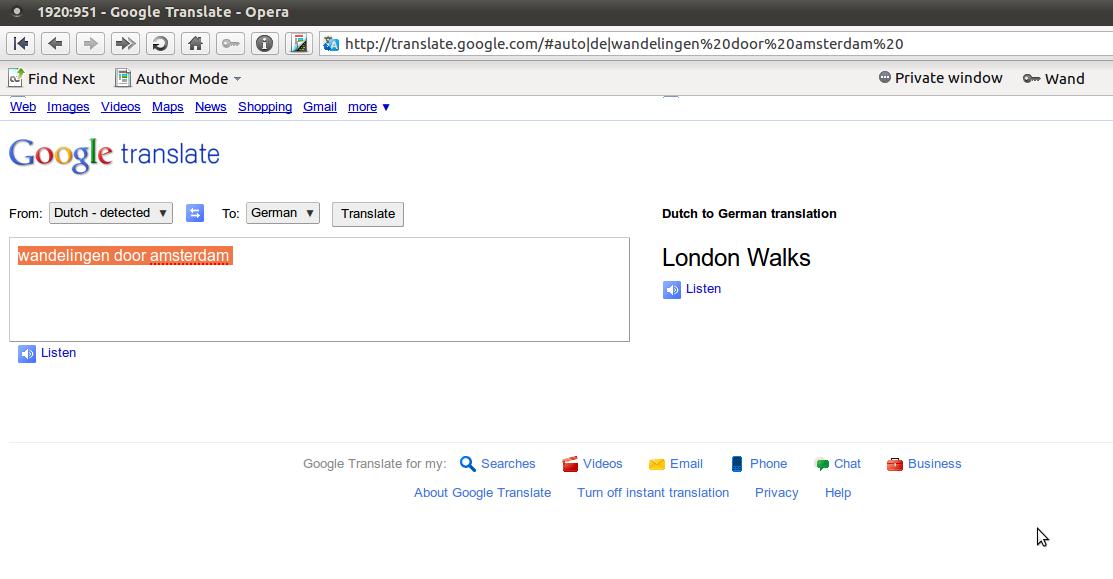
Maybe the two beautiful cities London and Amsterdam are battling to lure German tourists into their hotels. The English national tourist-agency just scored a superb goal:

London – Amsterdam: 1-0

A `wandeling door amsterdam` in Dutch  (`a walk in amsterdam`) is translated by Google to `London Walks` in German.

Really?

Trust me

Really!!

Read the rest of this entry »

Comments Off on The shadow of the invisible: AKA How to create fuzzy fonts with pure CSS

The shadow of the invisible: AKA How to create fuzzy fonts with pure CSS

{,}
October 7th, 2010

No, I wasn’t drunk writing this post, just had a long hot shower.

No, you don’t need new specs, this text is slightly blurred.

Scrubbing my back I was thinking about the new CSS3 stuff, and what you can do about spicing up the layout.

After my hot shower, steam filling my bathroom, I looked at myself in the mirror, razor-blade in hand to deliver a fast and clean shave.

Stop!

No shaving in the mist, no blood in the tub, but EUREKA
Fuzzy fonts with CSS!

How? Read the rest of this entry »

Comments Off on Will Microsoft add SVG support to Internet Explorer in the near future?

Will Microsoft add SVG support to Internet Explorer in the near future?

{}
January 10th, 2010

Microsoft has applied to join the World Wide Web Consortium (W3C) Scalable Vector Graphics working group. I would say ten years to late, but they did it. So will all the examples on this site work in Explorer soon. I hope, but I fear not. Let’s explain that to you.

Animated SVG Logo Webonomic

One of the reasons I write critically about Microsoft is that they’re trying to slowdown internet innovation, probably best illustrated by the so called Embrace, extend and extinguish strategy, which had the purpose to extend open standards with proprietary capabilities, and then using those differences to disadvantage its competitors.

As a consequence, and another big reason I don’t like Microsoft, they push the time and costs of developing websites by approximately 40%. Simply because you have to write your JavaScript twice, can’t use modern CSS and lose a lot of time fixing lay-out bugs. That’s the price the world is paying for the Microsoft dominance in the browser market. Other estimations go about 20-30%, the well know Dutch developer PPK on quirksmode “Want a site that works perfectly in IE6? Fine, but it’ll cost you about 20 to 30% extra.”. (Costs of JavaScript libraries are excluded here).

I think Microsoft used that strategy and I think they were successful. Actually Microsoft stopped developing their browser form 2001 till 2007. Second thought: there is only one way that Microsoft will change that strategy, loss of market share. That didn’t really happen, at least not on a big scale, seems that most consumers don’t even know the word browser, Explorer worked out of the box, the blue e on your windows desktop was a synonym for internet, and Opera or Firefox a program for hackers or activists. Most sites used Activex, or other proprietary JavaScript, so a lot of sites didn’t work in Opera, actually they were designed (deliberately) to only work in Internet Explorer.

Now Google (and to a lesser extent Apple) entered the browser-market, things are starting to change. At least the web is gonna change: sites do not longer contain information, they contain applications.

And when you use web-applications, you don’t need them as a stand-alone program. That’s the danger for Microsoft. It’s not new, it has always been there and Microsoft knew. That’s why they made their browser `a critical part of their operating system`, technically nonsense, but they reached their goal. I took the EC a few years to refute that claim, a few years Microsoft made a lot of money.

Why didn’t Microsoft embrace SVG earlier. Well they developed Vector Markup Language (VML) during the nineties. That didn’t became a standard, so I guess they decided to stop doing anything for 5 years. Now Microsoft gained some substantial marketshare with Silverlight, a Flash/SVG comparable technology, which it’s used a lot for streaming Media lately, they probably think let’s join the SVG working group to – these are my wordssee if we can slowdown their activities.

Will we see SVG support in Explorer 9. I bet not!

UPDATE

I was totally wrong. There is SVG support in Explorer 9.

I can take my loss, it makes me happy to see Microsoft embrace webstandards 🙂